02 January 2026


ARTICLE
REALTY: Budget to Boost Affordable Housing


ANUJ PURI, Chairman & Country Head - JLL India
Budget 2017-18 Gives a Boost to Affordable Housing The Budget that was being touted as a make-or-break one for the future of India and the government, made some big announcements on the infrastructure front and also on beneficial changes to the affordable housing segment. The Budget missed out on giving any additional income tax incentives to first-time home buyers or providing higher tax savings on housing loans and house insurance premiums. Nor did it raise house rent deduction limits. However, it did provide some direct tax relaxation to the lowest income earners, and gave some clarity on the designated beneficiaries under the Pradhan Mantri Awas Yojana (PMAY). A new Credit Linked Subsidy Scheme (CLSS) for the middle-income group with a provision of ?1,000 crore in 2017-18 was announced. Also, extension of tenure of loans under the CLSS of PMAY was increased to 20 years from the existing 15 years. Moreover, in rural India one crore houses are to be built by 2019 for the homeless and those living in ‘kaccha’ houses. Allocation to PMAY has been increased from ?15,000 crore to ?23,000 crore in the rural areas – and affordable housing will now finally be given infrastructure status. This is very significant, because it will provide the vital budget housing segment with cheaper sources of finance including, but not restricted to, ECBs (external commercial borrowings). Also, re-financing of housing loans by NHBs (National Housing Bank) can give a leg up to the sector. Under the latest provisions, developers to get one year’s time to pay tax on notional rental income on completed unsold residential inventory. The time limit for capital gains to be considered as a long-term gain has been reduced to 2 years from the earlier 3 years. More supply will enter the housing market now. The applicable exemptions for affordable housing will now be recognized on the basis of carpet area of 30sq.mtrs and 60sq.mtrs instead of on the basis of saleable area. The 30sq.mtrs limit will only be applicable within the corporation limits of the 4 major metros. For fringe areas of these metros and all other cities, it will be 60sq.mtrs on carpet area. This will effectively serve to increase the number of projects falling under this segment. Promoters of affordable housing projects will benefit from the following announcements: (a) JDs liability to pay capital gains tax will be in a year after the project is constructed. This will be beneficial for land owners and land prices can ease; (b) Instead of the earlier timeline of completing their projects within 3 years, developers now have a cushion of two additional years - these benefit can be passed on to home buyers. On the infrastructure front, a total investment of ?396,135 crore was announced in the Budget 2017. Budget allocation for highways will go up to ?64,000 crore in FY18 from the earlier ?57,676 crore. Allocation for national highways has been stepped up to ?64,000 crore from ?57,676 crore. The rural roads construction work will be accelerated to 133 km of roads per day in 2016-17, as against 73km/day during 2011-14. A new metro rail policy will be announced. On the FDI front, the FIPB (Foreign Investment Promotion Board) is set to be abolished and a new roadmap is to be announced in the next few months. This will give the real estate sector access to significantly more funding than it has today. A new FDI policy is under consideration, which promises to liberalize the FDI regime further.
Anshuman Magazine, Chairman (India and South East Asia)-CBRE
Year 2017 is expected to be the year of implementation of all the positive reforms that the government adopted in the year 2016. The union budget for 2017-18 is being seen as the necessary stepping stone to further encourage regulation and transparency in the real estate sector. Home-buyers are expecting announcement of tax incentives, reduction in interest rates on home loans and rationalization of stamp duties for Union Territories as well as simplification of the process of property tax assessment and collection by individual states. For developers, the expectation from the government will be to establish concrete steps towards Ease of Doing Business by allowing single-window clearance mechanism which will go a long way in easing the approval process for large scale real estate and infrastructure projects. The budget is also expected to extend the ambit of External Commercial Borrowings (ECB) for construction finance to a broader range of housing, while working in parallel on initiatives to lower home loan rates. Additionally, aligned to the Government’s flagship "Housing for all" by 2022 scheme, it is hoped that exemption of service tax under GST will be introduced to promote affordable housing. With the passage of the Real Estate Regulator Act expected to come into force by May 2017, the industry is hopeful of this long pending request to be granted.please post your comments & reviews
Your email address will not be published. Requried fields are marked*LET US KNOW WHAT YOU HAVE TO SAY:
Recent Comments
No Comments
NEWS
 1,00,000
FURNISHINGS: India Carpet Expo Attracts Buyers from 60 Countries
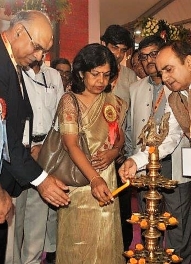
Varanasi hosted the 32nd edition of India Carpet Expo (ICE) on 3-6 October 2016; This was the for the
RESEARCH
 1,00,000
REALTY: The Return of The Investor in London – Ashley Osborne, Colliers International
Despite geopolitical shocks, real estate capital flows look well supported by the global economy; while investor confidence is notably improving
VIDEO